Wednesday, September 8, 2021

Somalia

ADEN ADDE AIRPORT 
While in Kenya I decided to commit to three days in Somalia using Visit Mogadishu Tours - something I’d planned to do in 2020 but had to cancel due to Covid-19.  The tour company arranged my visa invitation and told me to arrive at Aden Adde airport and get my visa at immigration. It was pretty simple, the only confusing part was finding the yellow application form in the arrivals hall. I was pretty much the last person processed out of the 40-50 people on my flight flight from Nairobi, most of which were Somali citizens. The cool thing about the arrivals area was I could see the guys from the tour company on the other side of immigration waiting for me.  The one page visa sticker, with photo included, cost $60 for a single entry ($42 for the visa plus an $18 service charge). 

Mohamed & Ali (yes, that’s correct) met me on the other side of immigration and quickly we were outside and seated in the car I was to spend the next three days in - a bullet proof Toyota Hilux with a dedicated driver and two armed security guards on the back bed. There were a few checkpoints within and immediately outside the airport; each with multiple armed security personal, huge concrete bollards and heavy gates.  

HOTEL SAHAFI
Hotel Sahafi is about 2km from the airport on a short back street with a security checkpoint at both ends and another security detail protecting the main gate into the hotel compound. The guys did a great job explaining what to expect during my stay - don’t get out of the car until given the all clear, no pictures of any security checkpoints or government buildings, expect to hear gunfire occasionally and under no circumstances leave the hotel compound on my own. 

Inside the Hotel Sahafi and the Toyota Hilux

The hotel is somewhat cavernous with a huge outdoor courtyard and restaurant, empty rooftop terrace and about 80 rooms of different shapes and sizes. The first room they put me in didn’t have a window so after a brief nap I was quickly moved to another smaller, easier to find room with a television stuck on one channel playing repeats of Indian soap operas overdubbed in English. Lunch at the restaurant was really good fish, rice and vegetables with coke to drink - no alcohol in Somalia.  I met the third member of the tour company, Omar, and paid the remaining balance of the tour in US $100 notes; One was slightly ripped so he said he may have to get me to use different one because the bank may not accept it.  He was right so before I left I gave him some twenties instead as that was the last of my hundreds.  In Africa, crisp new notes are a must - my bad for not checking before I left.

FIRST OUTING
After lunch was my first experience out and about in Mogadishu. The driver (cannot remember his name) is well accustomed to navigating the streets and stopping at the required checkpoints. He worked for Mohammed Farrah Aidid for a few months in the 1990's, driving him across the country numerous times to various locations, including over the border into Kenya. Aidid was the central target by the Americans in the Battle of Mogadishu (1993) - depicted in the movie Black Hawk Down. More to come on that tomorrow.

Mohamed, myself, the driver and two armed guards stayed fairly close to the hotel but visited a souvenir shop (the only one I saw during my stay), the Beerta Nabadda Peace Park (a popular wedding location), Mogadishu Mall (mainly empty but pristine clean indoor mall), and an excellent coffee shop called Home Bakery with great coffee and a wide selection of freshly baked cakes and pastries.  Mohamed made a few calls and before long we met a friend of his who works at a building not far from the bakery.  On the way we walked through some of the side streets and bought some fruit. I was asked more than once if I was Turkish. The Turks provided humanitarian aid in 2011 when the West largely ignored Somalia so there are a lot of Turkish nationals in Somalia. Erdogan's so called "Turkish Model" combined democratic governance and Islamic values with ambitious development plans aimed to neutralize western intervention.  Turkey rebuilt the international airport in Mogadishu, built it's largest overseas embassy on the shores of the Indian Ocean and a huge military base to the south of Somalia's capital.  Turkish is now widely observed as the second language of Somalia.

The building Mohamed took me to was a half completed, largely empty apartment complex where we went to the rooftop to get fantastic views of the city, beachfront and ocean.  After many photos and noting historic landmarks for tomorrows agenda, we headed to another great coffee shop, 5 Gen Cafe, for the last coffee of the day. It was located within the compound of another hotel where by chance I bumped into one of the people on my flight from Kenya yesterday.  We were both taking selfies on the tarmac in Nairobi before boarding and after landing in Mogadishu which is how we recognized each other.

SECOND OUTING
The second excursion away from the hotel was my favorite day in Somalia. Not saying the rest of my time here was not great, but today was something special and it started somewhere that didn't promise much. Expectations were low as we approached the Xamar-Weyne Fish Market near the medieval mosque on a rocky point jutting into the Indian Ocean. As I stepped out of the truck I couldn't help but think, 'the Seychelles are out there somewhere, what am I doing here?'.  I visited the huge fish market in Mwanza, Tanzania last year so by comparison this one was tiny but there was a staggering array of fish and lots of sharks. Moreover the fish mongers were happy for me to take photographs and pose with some of the big fish, including the sharks. The stench was terrible but for some reason I've always had a fascination with fish markets and, if you can get over the smell, there's some great sights and sounds to experience.  We spent about an hour at the market and wandering around the rocks behind the mosque taking photographs and making short videos for the tour website.  I made a few 20 second vignettes about how much I loved Somalia and how safe Mogadishu is - while the armed guards stayed conspicuously out of sight.  They didn't want to be photographed.  Not yet anyway.

Great white shark at the Fish Market
Around the corner from the fish market, we stop and find a man selling a giant turtle shell. Some words are exchanged, a small bribe too, and he ushers us behind some old tires and other junk to find a half dozen giant turtles, still alive, on their backs clinging on to dear life. I wasn't expecting it and not really what I wanted to see but there was nothing I could do about it. Time to move on to the curiously named Second Lido Beach.

The rocks behind the fish market
Past a few more derelict buildings then through a small alley leading to stairs down to the beach I set my eyes on the old Italian Lighthouse for the first time. It's a gloriously dilapidated building, no longer in service and I start taking photos almost immediately after I get the all clear to do so.  But down on the beach there are people yelling at me and I'm aware that there are lots of eyes directed towards me. Mohamed and Ali are both with me today so Ali tells me to hold tight while he heads towards the beach.  It's very crowded. Lots of people milling about doing not much at all, some people tending to boats, kids playing soccer but it becomes very apparent that people know I'm there and are a little uneasy. I'm uneasy too, wondering if my two armed guards are enough or even if they're even on my side. Ali comes back and things seem to have calmed down a little. He's found the 'Lighthouse Keeper', paid another small bribe and now we're okay to continue down to the beach.  

Second Lido Beach

Second Lido Beach is hard to describe - Google Maps says "Beach surrounded by ruined buildings." In truth the beach is also ruined; a dumping ground cleaned only by the rising tide but rewind to the 1950's, this was the highlight of Italian Somalia. It's a shame to see it so neglected today but for me it was the highlight of the trip.  I took a lot of photos here, played soccer on the beach and helped push a boat out across the sand.  Around the base of the lighthouse the rocks were covered in algae which made for a wonderful contrast of green against the blue sky and brown sand.  I never quite felt comfortable there though - I felt many sets of eyes on me at all times. Most friendly but others I couldn't quite tell.

The Italian Lighthouse on Second Lido Beach
The Battle of Mogadishu, known as the Day of the Rangers to Somalis, was fought October 3-4, 1993 between the US and Somali militia loyal to Mohamed Farrah Aidid. The movie Black Hawk Down was based on the events that unfolded during the botched attempt to capture Aidid.  He was never caught, 19 American soldiers were killed along with anywhere between 300 - 2,000 Somalis. Two  Sikorsky UH-60 Black Hawk helicopters were shot down and in the aftermath dead American soldiers were dragged through the streets by Somalis. This had a massive impact on US foreign policy in the region with a reluctance to interfere any further in Somalia and a blind eye turned to the genocide in Rwanda six months later.  The helicopters are long gone but at least two American tanks remain where they were abandoned near the Bakaara Market.  We drove to the first crash site site (not much to see these days) and saw the two tanks but there was no getting out of the car at any point.  The area around the market is not governed or administered in any way. There are no police, no law enforcement, no checkpoints, no real semblance of any type of organization or order.  The paved roads that are not severely potholed are either flooded, covered with debris or congested with goats, dogs, chickens and whatever else.  The dirt roads were even worse - some impassable except by motorbike. It was not a place to dwell for too long.

Next stop, the original Lido Beach, on our way passing the Arch of Umberto, a smaller Italian version of the Arch de Triomphe named after the King of Italy (1878-1900), and the 15th century Almnara Tower - both stops confined to the truck because of security fears.  Lido Beach is much busier than Second - more people, more games of soccer, hugely expansive and seemingly much safer.  Unlike Second Beach, some buildings are still in use and its in one of them that we stop for a delicious seafood lunch with an unparalleled view of the beach and ocean.  We're the only guests at the restaurant. Not far away is the Elite Hotel, bombed by Al Shabab about a year earlier but now restored to some version of its former glory.  After lunch is a boat trip along the coast to see the sights from a different angle and marvel at the masses of people in the water avoiding the boats and jumping the waves. A quick stop at the Tomb of the Unknown Soldier for photographs is followed by a long stop at the Heritage Hotel for coffee and cake.

THIRD OUTING
The last full day in Somalia revolved around a hospital visit, a trip to the bank and day out at the beach. After another huge breakfast at the hotel I was taken around the corner to a small clinic for my mandatory Covid test so that I could board my flight the next day back to Kenya. The test itself was uneventful and cost $25 but the lingering thought in my head was what would I do if the test came back positive for Covid - I'd be stranded in Somalia of all places. Don't get me wrong I was happy to be here but this was no place to dwell for very long.  Thankfully the test came back negative so the path was clear for me to get back to the 'relative safety' of downtown Nairobi tomorrow.

Calling the next stop a bank would be stretching it a little bit - it was more like a small shop with a large safe in the center. The US dollar is accepted pretty much anywhere a tourist needs to go in this country. Apart from the payment to the tour company in cash, the only time I actually bought anything was on the first day when I found some old Italian era banknotes in the souvenir shop.  Everything else was paid for electronically by Mohamed and I paid him back in cash at the end of my stay. The only legal tender Somali Shilling banknotes are in denominations of 1,000 which is the equivalent of about 5 cents.  Part of the appeal of coming to the 'bank' is so that you can sit there in a chair beside the safe while they pile stacks of cash three feet high worth a mere few hundred dollars. Most of the banknotes have passed through thousands of pairs of hands, are torn, oily, filthy.  Sanitizer is required after handling but the experience was funny.  We stop at a couple of camel markets on route to the beach to pick up milk and take pictures.

Camel Market: My Wesley Snipes lookalike bodyguard
Jazeera Beach is about 12 miles (20 km) south of the southern most part of Mogadishu where the airport is located but the drive takes over an hour. Some of the route is paved but most is dirt or sand and a lot of it is severely potholed. Omar is along for the ride today and he's brought his drone to make more videos for their website. The beach is nice and there's an island close enough to wade to while the tide was out.  It's very picturesque and well worth the trip.

Jazeera Beach
BACK TO KENYA
Mohamed accompanied me back to the airport, through about half a dozen different check points before finally making it to the terminal.   When I landed, I got the Somali visa in my NZ passport.  The visa for Kenya was in my US passport. This caused a problem at immigration and I was taken aside while they figured out what to do with me.  I should have used my US passport both visas but I wasn't thinking clearly when I landed here three days ago.  After about 20 minutes it all seemed to get sorted out with plenty of help from Mohamed who was keen to make sure I got away okay.

Somalia is the most dangerous place I've been to up until now but the tour company really did a great job at making me feel safe. They didn't cut any corners. They didn't try to shake me down for any additional services. They were genuinely interested in making sure my trip was comfortable. 

SOMALI PROVERB
The world is like a shadow; in the morning it is turned towards one direction, in the evening towards the opposite one. (i.e., things change)

Wednesday, March 18, 2020

Zanzibar

WELCOME TO TANZANIA.  NOW WHAT?
Forced to leave Egypt with very little notice, I chose to fly to Tanzania, for a few good reasons - visas are issued on arrival, it's relatively cheap, I haven't been there before and there's a ton of things to do (safari, Kilimanjaro, Maasai tribes). Tanzania would be U.N. country #108 for me.  There was a mandatory temperature check on arrival and a standard form to fill out but securing a three month tourist visa was quick and easy.

I withdrew some cash from an ATM and got a taxi from Julius Nyerere International Airport to the ZanFast Ferry Terminal and purchased a one-way business class ticket to Zanzibar for $20. It was a bit of a mess getting onto the boat with every passenger trying to board at the exact same time, but once upstairs and in my airconditioned seat it was smooth sailing for the two hour trip across the archipelago to Stone Town. Another temperature check on arrival, a heaving mess at baggage claim where all the porters wanted to help and another medical form to complete before escaping the ferry terminal. 

Stone Town is gorgeous. It was sunset as I walked the short distance from the ferry terminal along the seafront past big tree beach to the Double Tree Hilton hidden away behind Freddy Mercury’s childhood home. I circled the thing a few times before a kindly security guard help me find the front door. 

Zanzibar at sunset

The Double Tree was beautiful. It was a warm evening when I arrived and shortly after settling in I retreated to the rooftop restaurant to relax and reflect on the chaos of the last few days. As Covid was ramping up around the world, I’d just passed through five huge international airports and a bustling ferry terminal armed with nothing more than a bottle of hand sanitizer. No masks in Africa yet. In fact, none will be seen for the next six weeks - not until the day I would finally leave this country. 

The Anglican Cathedral in Stone Town

Stone Town is a UNESCO World Heritage Site - by definition a place judged to contain cultural and/or natural significance and considered to be of outstanding value to humanity. There were lots of options and plenty of  time so the plan was to take a few days on foot around the old city to stumble upon;
  • The Old Anglican Cathedral - made from stone with a lovely alter and slave chambers next door.
  • The Persian baths - built for the former Sultan of Zanzibar. 
  • Zanzibar coffee house - a cafe and hotel with excellent food (and super fast WiFi)
  • The People’s Palace Museum - a 19th palace, sadly closed to tours
  • Big Tree Beach - next to 'the big tree' and close to the ferry terminal, it's a bustling part of town with lots of little cafes. 
The next day was set aside for Freddy Mercury’s House, some shopping and a trip to Prison Island to visit the giant tortoise sanctuary. I forget how many tortoises are on the island - safe to say more than 50 - but some are much older and more revered than others. They have their birth date painted on their shells and the oldest one I saw was over 150 years old.

One of the tortoises on Prison Island
After a couple of wonderful days cramming in as many sites as possible it was time for a change of location and a change of pace.  In the very north of Zanzibar is a small village called Nungwi, known for great diving, excellent seafood and the second DoubleTree Hilton on the island. 
Leaving Prison Island

I booked three nights but ended up staying five. My ocean front room was too good to give up without a fight, plus I needed time to plan my next move. Each of the next few days followed a familiar pattern - watch the sunrise, quickly followed by the news for any Covid updates, breakfast, pool time, lunch, more news, beach time (mainly taking photos versus swimming), news, dinner timed to watch sunset from the beach. Interspersed with this routine were various conversations with other tourists either planning their early route home or, like me, holding out for better news in the hope that I could get my trip back on track. 

Per my original plan I should have been on the island of Socotra in Yemen, off the Horn of Africa.  It was hard to be unhappy where I was but I had a sinking feeling that I was either going to to be forced home early, or get stuck somewhere. Turns out both scenarios would play out. 

With each passing sunrise and sunset in Nungwi, the DoubleTree guests at breakfast and by the pool and sunning themselves on the beach and wandering the grounds, dwindled noticeably. The morning I checked out was eerie. I was the only guest at breakfast. I wandered to the empty market and arranged a taxi to take me to the airport. At the checkout desk I asked how many rooms are at the resort. Ninety four was the answer. How many rooms are occupied was my next question. The answer;  “After you leave, just one.”  Two hours later I was at the airport about to head to the mainland, for safari, for wildlife, for adventure. And I was about to get an awful lot of alone time. Next stop, Arusha.

Tuesday, March 17, 2020

Less than 24 hours in Cairo

AN ABBREVIATED VISIT TO EGYPT
One day into a planned ten week trip round Africa and plans had to change quickly to account for the rapidly escalating situation with Corona virus. Border closings and flight cancellations and hotel closures and changing tour arrangements and quarantine restrictions and any number of travel issues would plague the next few weeks. This was just the start, but it was a bad start.

The Pyramid of Khafre

On my way Cairo I found out that all international flights into and out of Egypt would be suspended from March 19th.  I arrived early morning, 3am, Tuesday March 17th. Egypt, specifically Cairo, was to be a transit hub over the next few weeks with trips to Yemen (already cancelled) and Lebanon all transiting through the Egyptian capital.  I had to make some hasty schedule changes but needed to get to a hotel with stable WiFi so I could make some bookings. The first wrinkle was the Airport Hilton Heliopolis was CLOSED completely when I arrived in the taxi at about 4am. With no cell signal and a taxi driver who didn't speak English we headed to Tahrir Square where I knew there would be some big hotels close to the Egyptian Museum.  I ended up at the Hotel Cleopatra - a typically bland but clean local hotel with a nice view over the square and the museum. I'm sure I paid too much for the room but by this point I needed a place to unwind and get flights booked.

Inside the Pyramid of Khafre


The Sphinx

After quickly booking a flight leaving later that night to Dar Es Salaam (Tanzania) I took a shower and a power nap and headed straight to the Pyramids of Giza. I've been at least twice before but this time was simply to grab some better photos and enjoy a leisurely day in familiar surroundings.  The weather was beautiful and the local guide was really good. The pyramids are about a 30 minute drive from Tahrir Square but subject to traffic - it was a slow day in the Egyptian capital and before I knew it I was wandering around the Giza complex and finished up at the Sphinx.

This is as high as you can climb the pyramids

On the way back to the city I stopped for shopping and a lovely dinner and coffee at the Oldish Cafe close to Tahrir Square but all too soon it was time to head back to the airport for the next little adventure. Excited to be travelling again, even if off course, but Tanzania would be another new country (#108) with the added bonus of Zanzibar. 

The Oldish Cafe
 

Saturday, July 1, 2017

Slovenia

LJUBLJANA
We watched the All Blacks lose to the British & Irish Lions at an Irish Pub in Zagreb in the morning before catching the three and a half hour bus to Ljubljana, the beautiful capital city of Slovenia (birthplace of Melania Trump).  We chose to stay for two nights at the very quirky Hostel Tresor in the central city fifty steps from Preseren Square and close to the triple bridge - the one with the dragons on it. The hostel is in a refurbished bank, all the rooms are names after global currencies and breakfast is in the converted bank vault.

Hostel Tresor in Ljubljana
From the city we walked over the bridge and up the hill to Ljubljana Castle, a medieval fortress over looking the city and surrounding countryside. It's an easy, beautiful walk with plenty of places to stop, rest and take pictures. The castle has lots of exhibits and top of the main tower has a huge national flag (I love flags) and the best views of the city.

The path to Ljubljana Castle

Ljubljana Castle
The view from the tower at Ljubljana Castle

The following day we rented a car and drove north on the E61 to Bled to visit the fairy-tale 11th century castle overlooking Lake Bled. It's the oldest castle in Slovenia and one of the top tourist attractions, but it wasn't particularly crowded. There were lots of places to explore and exhibits to wander through. The kids got the best ice cream ever and Seb ended up wearing most of it on his face.

Seb looking down to the lake

Sunday, June 25, 2017

Bosnia & Herzegovina

MOSTAR
From Dubrovnik it's only a few minutes drive to the Bosnian border and only a couple of hours to the city of Mostar. Mostar is known for the beautiful medieval old bridge over the Neretva river and it's one of the best examples of Islamic architecture in the Balkans.

I booked the Elite Guesthouse ahead of time and the owner, Misha, arranged to meet us at one of the bigger hotels on the outskirts of town with his motorcycle so that he could guide us through the maze of streets to a safe place to park. It wasn't too difficult but it was a nice touch and he let Sebastian sit on his motorbike as we walked the final few hundred yards. Our room at the guesthouse was huge, with a kitchen, washing machine and a nice terrace with a view of the river and only a short walk to the old bridge.


MOSTAR BRIDGE (STARI MOST)
Known as the 'Old Bridge', Stari Most is a rebuilt 16th century Ottoman masterpiece and the highlight of Mostar. It was originally commissioned by Suleiman the Magnificent in 1557 and stood for 427 years until it was destroyed in 1993 during the Croat-Bosniak War. The bridge we see today was rebuilt and opened in 2004 but still looks amazing and better still it was uncrowded.

We spent an afternoon wandering slowly up the cobblestone streets past the Biscevic House and the Koski Mehmed Pasha Mosque until the bridge came into view in bright late afternoon sunshine. We stopped in a few markets and had to negotiate a few gypsy children that were hanging around and settled into a lovely dinner spot with a perfect view of the bridge. There were a couple of high divers hanging about on the bridge and apparently if you paid them enough they would dive into the river below. We hung about for a little bit but I never actually saw anyone dive.  After dinner I stumbled upon a little shop selling foreign banknotes so everyone left me behind while I searched through a few binders looking for something unique.

The cobblestones leading to the bridge

Stari Most
The kids by the Neretva River under Stari Most
The following day we drove to a few of the interesting sites nearby; Blagaj - an Ottoman style monastery and national monument built around 1520,  Počitelj - an historic village and an open-air museum nestled on the side of a hill beside the Neretva river, and the Kravice Waterfall where the kids swam while Glen, Ale and I had a few drinks in the sun.  The waterfall was a bit crowded, and very slippery in places but well worth the visit.

DON'T MISS SARAJEVO
The next day we tried to find Tito's Bunker but we had a few navigation issues, plus we hadn't booked. We weren't going to be allowed inside so we carried on to Sarajevo where Glen wanted to visit the Tunnel Museum which is a small military-history museum at the site of a storied Bosnian War–era underground tunnel not far from the center of the city. It was a somber experience but a necessary experience to understand what happened during what was the longest siege of a capital city in modern warfare in the early 1990's.  In the city we stopped for lunch and drinks then found the Sarajevo Museum 1878–1918 and the famous inscription the marked the event that would herald in the Great War;
 "FROM THIS PLACE ON 28 JUNE 1914 
GAVRILO PRINCIP ASSASSINATED THE HEIR 
TO THE AUSTRO-HUNGARIAN THRONE 
FRANZ FERDINAND AND HIS WIFE SOFIA"

No time to waste. We drove to Makarska, back in Croatia, and caught a car ferry to the island of Brač which would be home for the next two days.

Friday, June 23, 2017

Dubrovnik, Croatia

DUBROVNIK
Dubrovnik has been around since the 7th century when the Greeks fled north to escape the barbarian invasions. They built walls around their settlement and established trade and a port which, for the next thousand years, would be known as Ragusa. It wasn't until the fall of the Austro-Hungarian empire that the city changed it's name and built an industry around tourism. In recent times the city was senselessly bombed by the Yugoslav army in 1991 but recovered to earn UNESCO World Heritage status and become one of the most iconic spots on the Adriatic Sea. It is absolutely beautiful, very similar but much bigger than Kotor but many. many more tourists. Too many for my liking.

The bus from Kotor in Montenegro took about two and a half hours to reach Dubrovnik with stunning views of the Adriatic for the last thirty minutes or so. We were deposited near the cruise ship terminal but quickly got a taxi to Srebreno beach and our apartment for the next few nights. While it would have been great to stay within the old city walls, there is a ferry from Srebreno beach to the 'Porat' entrance to Dubrovnik.


GAME OF THRONES TOURISM
The best way to see the city and take in the location and views is to walk around the city from the ramparts above. The views are stunning and there are plenty of places to stop for photos and grab a drink and something to eat. The best way to explore the city is to get lost in the streets and alleys below.  There are a bunch of 'Game of Thrones' themed tours but we opted instead to explore without a map or guide - and to be honest that's the best way to do it. We stopped frequently for ice cream, or beer or food and even more frequently for photos.


For me one full day in Dubrovnik was enough for me. Although the photos may not show it, the place was teeming with tourists and at times I was worried about getting separated from the kids.  This was one of the few places where we organized a meeting point (the clock tower) should we lose each other during the day, but thankfully it never came to that.


NEXT STOP BOSNIA
Tomorrow is Sunday. We're scheduled to pick up a Sixt rental car from the city which we're going to drive all the way to Zagreb in the north. Along the way we're catching a car ferry to a Croatian island, but before then we're headed to Mostar and Sarajevo for a slide of history tour in Bosnia. I can't wait.

Wednesday, June 21, 2017

Montenegro

THE CITY OF CATS
We were up early to catch a taxi to the Tirana bus station and eventually boarded the bus bound for Montenegro, via Podgorica and then the stunning capital city, Kotor - also known as the city of cats. Kotor is one of the most beautiful walled cities I've ever seen, smaller than Dubrovnik but big enough to get lost in for a little bit. Lots of nice courtyards with appealing restaurants and shops and some lovely churches. Lily and Seb had fun playing with the numerous cats wandering all around the place and even tried talking me into buying a kitten.

Seb & Lily playing with kittens in Kotor

Kotor from the top of the old fort trail
We stayed at the Kotor Old Town Hostel just inside the entrance to the old town and easy walking distance from the bus station. The hostel is in a rustic 13th century stone building and had recently been refurbished. It's an excellent location with a tourist desk next door and plenty of restaurant options right around the corner. We wandered around the narrow alleys and stunning courtyards for the afternoon and stopped for pizza and ice cream.

A DAY OUT AND ABOUT
We took a day tour of Montenegro with a bunch of other like minded tourists out of the city and around the bay of Kotor taking in sights like 'Our Lady of the Rocks' (a small lighthouse in the middle of the bay), Slano lake and the beautiful Piva Monastery.

Our Lady of the Rocks - Seb, Lily, me, Glen & Ale
ZIPLINING IN PLUZINEAfter Piva Monastery was the highlight of the day - a monstrous zipline over Pliva Lake. Both kids were brave enough to take it on and loved it. It was a thrilling was to end the afternoon before starting out for Ostrog Monastery.  We would never make it there though. The tour van broke down several times and we were losing precious daylight at the driver tried without luck to get it fixed properly.  We had to abandon the monastery and head back to Montenegro, hours behind schedule.  The silver lining after all the waiting was that the tour company generously reimbursed the full price of the tour for all five of us.
Viaduct over Pliva Lake.

The zipline group
Montenegro was a surprise.  Next on the list was Croatia and the city of Dubrovnik!

Monday, June 19, 2017

Kosovo

KOSOVO - COUNTRY OR NOT?
A country is a country if enough other countries agree that it is a country. Kosovo declared independence from Serbia in 2008. Although the United States and most members of the EU recognized Kosovo's declaration, Serbia, Russia, and a significant number of other countries, including a few EU members, did not. So officially, Kosovo is not a country and is not a member of the United Nations. Although it doesn't count towards completing the U.N list of 193 countries, it is a significant and intriguing place to visit.

The border crossing from Albania into Kosovo was very quick - less than 10 minutes. And a significant portion of that time was taken up verifying that Ale and her Chilean passport were welcome without a visa. The outbound crossing the following day would be even quicker, even with another Chilean passport check. The road between Tirana and Kosovo is excellent

OF MOSQUES AND MEN
The population of Kosovo is about 95% Albanian and predominantly Muslim. This became immediately obvious as the small town we stayed in, Prizren, boasts more than 40 mosques, all of which were blasting the call to worship as I was parking the car. It was difficult to miss. We were here during Ramadan and were told but someone in Albania that we should head to the Kaljaja (Prizren Fortress) for sunset, to hear the call to worship and see some fireworks.  The town was very quiet and the fortress was an easy 15 minute walk up the hill behind our hotel. We took a bottle of wine took in the stunning views and watched both fireworks - yes, only two - before wandering back to the town now teeming with men, women and children out for dinner.

Atop Prizren Fortress at sunset
TWO GREAT MONASTERIES
We spent an entire day driving around Kosovo in search of two UNESCO World Heritage sites as well as the capital city - Prishtina.

First stop was the Visoki Dečani Monastery near the town of Desan on the western side of Kosovo about 90 minutes drive from Prizren in the south. It is one of the most important monasteries of the Serbian Orthodox Church, famous for its elegant and peculiar architecture. It dates from the XIII century and mixes western and eastern church building styles to create a hybrid style only seen in old Serbia. This monastery is particularly noted for some of the world's finest medieval frescoes including a kick ass one of Jesus holding a sword - nothing like it anywhere else. Sadly though, no pictures allowed inside.

Visoki Dečani Monastery
Next stop was an excellent lunch in Peja at a restaurant called Kulla e Zenel Beut, then the second monastery, the Patriachate of Peć, 2 km west of Peja city center. Dating from the XII century, this is the mother church of the Serbian Orthodoxy. Another stunning interior with many spectacular frescoes but, once again, no photos allowed.

The Patriachate of Peć
It took the best part of two hours to drive through the center of the country to Prishtina on the eastern side. We had to play Tetris to park the car then walked around the old clock tower and through a market where we stocked up of football jerseys and golden eagle energy drinks.  From there we took the long drive back to the Albanian border to Tirana airport through town with names like Kukes, Rubik and Milot. By 11pm we were back at Tirana Backpacker Hostel for the night.


Friday, June 16, 2017

Albania

BALKANS 2017
The kids and I embarked on our most ambitious and complicated overseas trip yet. Seven countries (five new ones for me), at least ten border crossings, five flights, four buses (one overnight), two rental cars, one high speed train, ten different hostels or hotels a ferry and a whole bunch of memories. This is the Balkans tour of 2017 with Glen and Alexandra (Ale).

100 U.N COUNTRIES
I've been at this travel business for a long time and while all places are memorable for one reason or another, Albania will always be special to me because it is the 100th U.N. country visited. Only 93 to go to complete the set!

Tirana was great. With Seb and Lily I picked up an SUV rental car from Tirana International Airport and drove to the Backpacker Hostel in downtown Tirana.  We took a self-guided walking tour around the city to get bearings, withdraw money and scope out a place for dinner that evening. Glen and Ale arrived at around 7pm - the first time I've seen them since Chile a couple of months ago (but it seemed longer). Sadly the dinner place was closed but we stumbled upon a nameless seafood place where we were the only patrons. It was a really nice meal and a beautiful evening in Albania's capital but I doubt I could find the restaurant again. We went to Skanderbeg Square and saw the Et'hem Bey Mosque & Clock Tower while the kids played in the water fountains. The square had just recently opened and the entire thing is essentially a water fountain.

The next day we drove to Berat via Fier where we visited the Greek ruins of Apollonia. The ruins were a great way to spend a few hours and we had afternoon tea at a neat little cafe. During the drive I got waved down by one of the many police officers beside the main road. I didn't know that it was a requirement to drive with lights on at all times but the police officer was kind enough to reach into the car and turn them on for me once he figured out I couldn't understand Albanian.


The Greek ruins at Appolonia

THE TOWN OF A THOUSAND WINDOWS
The town of Berat, about three hours south of Tirana, is known for its historic architecture and scenic beauty. It's called 'the town of a thousand windows', due to the many large windows of the old decorated houses overlooking the town. In July 2008 the old town, called Mangalem district, was given UNESCO World Heritage status.  There are plenty of gorgeous sites within easy walking distance - the church of the holy trinity, the citadel, Berat castle, the ethnographic museum and the panorama of the town from high of the hill. It's a stunning place, unspoiled by mass tourism and delightful at every turn. I didn't want to leave after only two days there but I didn't want to miss out on some of the other hidden treasures of Albania either. We had to keep moving.

The view of Berat from Berat Backpackers

Beautiful view of Berat
EASY ON THE EYE, TOUGH ON THE TONGUE - GJIROKASTER
The old town center of Gjirokastër is another UNESCO World Heritage site, described as "a rare example of a well-preserved Ottoman town, built by farmers of large estate". We took a detour to check this place out and it didn't disappoint. This would be the southern most point of the trip - from here it's pretty much north all the way until we get to Paris in three weeks.

Gjirokastër can be divided into roughly two halves, the old town up on the hill, and the new town in the valley below. The castle is the historical and geographical center of the city and where we spent most of our time. The views are amazing and there is a lot to explore including an armaments museum, various chambers in differing states of disrepair and a couple of large open areas used for folk festivals. Dinner was on a lovely little terrace at a restaurant called Kujtimi not far from the huge Kodra hotel. We stayed for sunset and wandered around the old city streets for a while before driving back to Berat (about two hours away) for some late night drinks at Berat Backpackers.

Tomorrow is another new adventure as we drive over the border into Kosovo.

Saturday, July 4, 2015

St Pierre & Miquelon

WHAT, WHERE?
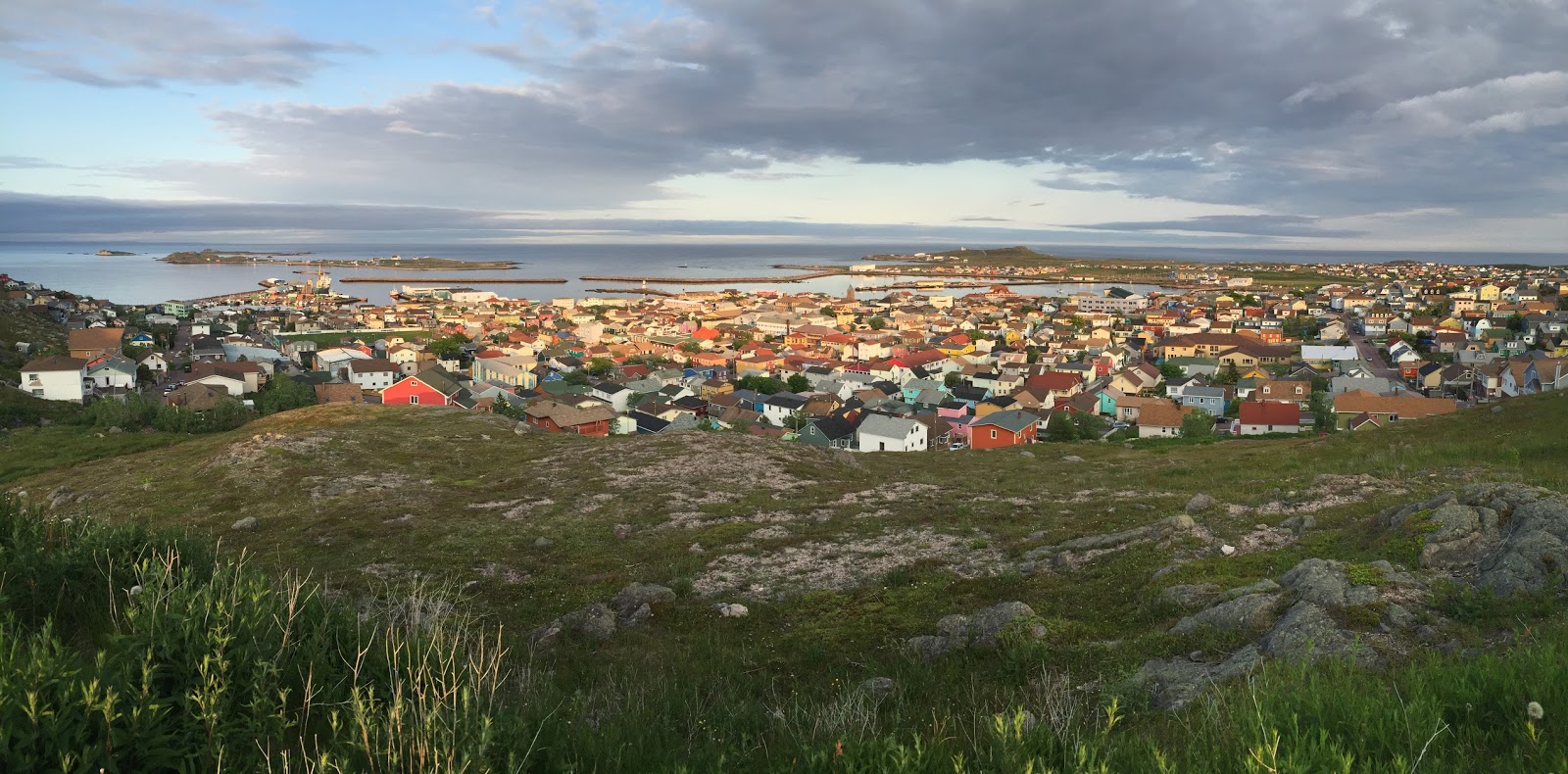
Lily, Sebastian and I ventured to Saint Pierre and Miquelon, a self-governing overseas collectivity of France in the northwest Atlantic near Canada to seek out the last outpost of French colonialism in the region. The tiny islands of St Pierre & Miquelon (pronounced 'meek-lon) are nestled about 30km from the southern shore of Newfoundland and 3,700km west of European France. No doubt about it, this place is French. They fly the tricolor, spend the Euro, eat baguettes for breakfast, drive badly, make great coffee, close for lunch, drink wonderful wine and walk their poodles while smoking Gauloises. This is France. In North America.
The town of St Pierre from the lookout
GETTING HERE
We flew from Dallas to Boston then drove for the best part of two days through Massachusetts, New Hampshire, Maine, New Brunswick and Nova Scotia to the airport at Sydney for our flight to St Pierre. We were early for the flight and because we were the only passengers, the flight left an hour early. Our pilot, 21 year Dominic, had just received his pilots license in the mail and was excited to be taking his first paying passengers across the Gulf of St Lawrence to the tiny St Pierre airstrip. On learning this, I was not so excited.

Boarding Air St Pierre

St Pierre from the plane
The airport in St Pierre is less than 20 years old and because we were on the ONLY flight of the day we passed through immigration and customs in record time. In fact there was no customs. And the immigration officer left the airport for the day as soon as he finished stamping our passports. He was quickly followed by the pilot. The only unfortunate part was that because we were early, the taxi I had arranged with the hotel wasn't at the airport yet. We were the only ones there. After a quick phone call and a short wait we were at the brand new Hotel Jacques Cartier and it was fabulous - massive rooms and close to absolutely everything.

SOME FACTS
About 7,000 people live on the islands of Saint Pierre and Miquelon, but there are almost 5,000 cars and barely 100km of roads. Almost everything is imported from either France or Canada, and the modest exports all come from the sea - fish, mollusks and crustaceans. There have been over 600 shipwrecks since 1800. Even at the height of summer it was cold and wet every day we were there.


EXPLORING ST PIERRE
A couple of days were spent wandering the streets of St Pierre and taking in the local highlights - the waterfront area, the lighthouse, cathedral, lookout point, and the many interesting houses. We ate at numerous cafes but the ones that stood out were Le Feu de Braise which had the best steak frites, Cafe du Chat Luthier just around the corner from the hotel and Les Delices de Josephine which had some of the best pastries around. The kids tried all of the ice cream shops and we all enjoyed the fresh bread everyday.

The waterfront and lighthouse

The Zazpiak Bat court
Just behind the cathedral is a place called Fronton Zazpiak Bat - which is a big red wall with one court on each side for a game called Jai-Alai. I didn't see any games being played but basically two people take turns at hurling a ball against the wall with a big scoop, trying to get it past the other. It's supposed to be one of the fastest sports in the world and is very popular in the Basque region of Spain. It looked impressive because the wall is huge, bright red and stands out like a beacon.

EXPLORING MIQUELON

At the tourist office in the town square we booked a day trip to Miquelon. We chronically underestimated how cold and windy it was going to be but our tour guide was kind enough to stop at her house and get some warm clothes for the kids to wear during the trip. The ferry was pretty rough and Seb vomited on the way over but once we got to Langlade all was well.
The zodiak with the main boat in the background

The drive from Langlade to the town Miquelon took us along the narrow isthmus and around the western coast to the very north of the island. The town is unremarkable but the church is pretty and the boats make for some very picturesque photos. There's a neat little museum with lots of nautical artifacts showcasing the unique history of the islands.

The church in Miquelon
There is a grave in the local cemetery for a British sailor - I forget his name. Legend has it that when you stand on his grave, you are actually standing in England. So the kids took turns jumping on and off the poor sailors grave because they really wanted to go to England.

Central Miquelon
I was quietly impressed with Saint Pierre and Miquelon - the food was fantastic and being 'in France' made it feel European somehow. But even in summer the weather was awful and everything is very expensive. I'll probably never go back, but I'm glad I've been.

Monday, March 2, 2015

Chatham Islands, New Zealand

TUESDAYS WITH BARRY

For something a little different, yet vaguely familiar, my Dad and I decided to take a short trip to New Zealand's eastern outpost, the remote Chatham Islands with a population of barely 600. The Chatham's have officially been part of New Zealand since 1842 and include the country's eastern most point, the beautifully named Forty-Fours, but if you ask any Chatham Islander they'll tell you this isn't New Zealand. And to make the point, this is the only place on earth to observe Chatham Standard Time Zone -  confusingly forty-five minutes ahead of New Zealand.

Flights to the islands on Air Chathams (in a Convair 580) depart from Auckland, Christchurch or in our case Wellington. The scarcity of flights mean passengers and freight share the main cabin. The first 15 or so rows of our flight were taken up with all sorts of household goods covered in blue plastic wrap. After a brief delay the flight took off and about an hour and a half later we landed at remote Tuuta airport next to a large lagoon far away from any sign of civilization. There's no public transport on the island so it's essential to have accommodation booked in advance. Dad arranged a rental car at the airport - an old Honda CRV with the keys permanently stuck in the ignition. We found the proprietor of the Hotel Chathams, who also doubled as the rental car agent, and followed her, via a quick stop to take in the views or Petre Bay, to the Chatham Rise annex, a few hundred meters from the main hotel in the capital city, Waitangi (population 200).

Petre Bay looking towards Waitangi
Hotel Chatham is pretty much the only game in town. The only pub, the only restaurant, the only hotel, the Air Chathams air hostess doubles as the bartender and the fish and chips is a bargain at $25 a plate.  After dinner we took a drive along Port Hutt Road to the tiny village of Port Hutt, stopping at the Basalt Columns at Ohira Bay along the way. The hexagonal columns are similar to the Giants Causeway in Ireland but much smaller (so I'm told since I haven't been to Giants Causeway). The funny thing about getting there was that the bay is on private land so we had to get permission, and a key to unlock the gate, to access the farmland the columns are next to. The directions went something like; drive through the gate, turn right at the picnic table, avoid the sheep, over the rise and down to the park bench. We arrived not  long before sunset and had the place to ourselves. The only two tourists at Ohira Bay that evening.

Hotel Chathams, our Honda CRV and Dad
The Basalt Columns at Ohira Bay
The next day we joined a tour group and left the rental car in Waitangi for the morning and headed to the south eastern coast along the Waitangi Tuku Road past beautiful coastline and stunning farmland. On the way back we encountered a New Zealand traffic jam as a farmer herded a flock of sheep along the main road between two paddocks. Back with our own car in the afternoon we followed the tour group to the Ocean Mail Scenic Reserve, the town of Kaingaroa, the seal colony at Port Munning (again only accessible only through private farm land), and the remains of the Sunderland flying boat in an old farm shed (on the same farm).
The loading ramp at Kaingaroa

Dad and I at Port Munning
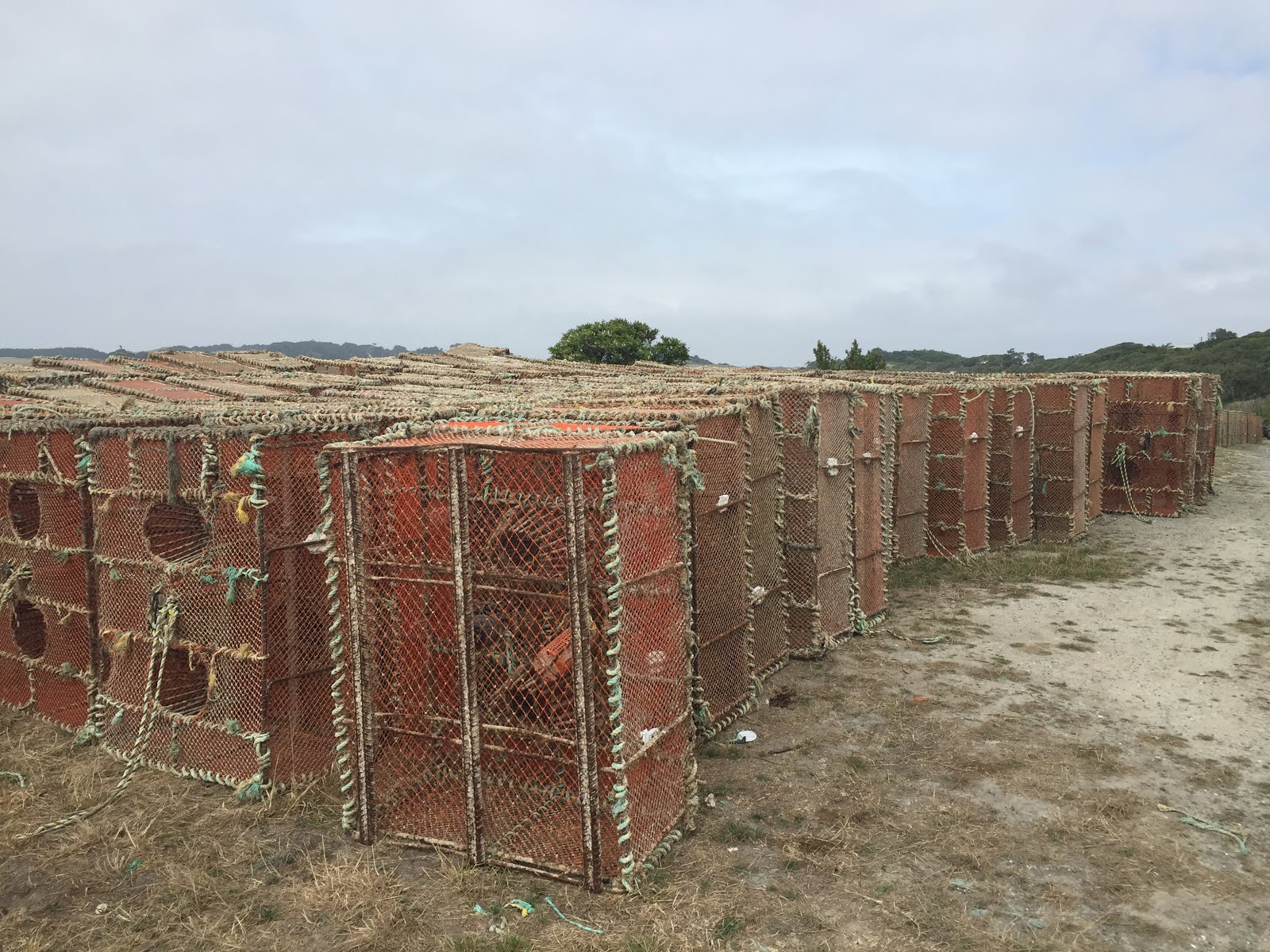
Crayfish pots - Kaingaroa
We left the tour group late in the afternoon and drove to the south eastern coast in search of the best views of Pitt Island. It was another case of following hilarious directions; turn off the main road at the fish factory, through the gates, follow the fence line, past the cattle, over the ridge to the cliffs of Manukau Point. The cliffs are amazing and the views stunning and once again we were the only people for miles around. It was incredibly serine and the great weather meant we could easily make out Pitt island in the distance of the south coast.

The southern coast of Manukau Point, near Owenga
The last stop of the day was the statue of the Chathams most famous son. Tommy Solomon was the last full-blooded indigenous Chatham Islander, or Moriori. He was however, not the last Moriori. His own descendants and the descendants of other Moriori live on today. He died in 1993 but his statue, erected in 1985, sits on the property of his descendants, on the eastern corner of the island near Owenga, facing eastward and staring out across the Pacific. As with most places we visited during our two days, we were the only two people there, surrounded by Tommy's spirit.
Dad talking to the Tommy Solomon statue
Everyone we met said two days was not enough time and they were right. The trip was far too short but it was brilliant to be somewhere familiar, yet so different all at the same time. As the locals will tell you, this is not New Zealand.