Wednesday, May 14, 2014

Port-au-Prince, Haiti

BORDER CROSSING
Land border crossings are always an adventure but after doing five in West Africa in quick succession I wasn't too worried about this one - neither of us needed visas so there was nothing more than a few forms and a couple of questions about where we were staying and why the heck we wanted to come to Haiti if not on a mission trip. Everybody was very nice and we dressed in our fake football jerseys for the occasion - me in Arsenal and Seb in Brazil - which always leads to much hilarity with people yelling out player names and assuming that we are Brazilian, or English. Immigration on both sides was all over fairly quickly but there were a lot of trucks crossing at the same time, hence lots of customs checks, which meant we had to wait in our tourist bus for about 2 hours as we crawled between the two immigration posts (about 1km apart).

Seb & I crossing the land border from Dominican Republic to Haiti
The border crossing near Jimani is really quite scenic but a little chaotic at the same time. The road is well paved on the Dominican side but Jimani is a forgettable little place and like most border towns does a big trade in money changing and cheap food stalls. The Haitian side is on the southern shore of Lake Azuei which is stunning but the road deteriorates in the no-mans-land to a graveled pot-holed mess. There appeared to be some work going on to improve the road but I wouldn't have thought the state was due to the 2010 earthquake.

After about three hours in the border crossing segment of the trip the bus finally set out for Port-au-Prince at about 5pm and it took the best part of three hours to travel the remaining 60km to the bus terminal in Petion-Ville, a relatively nice suburb of Port-au-Prince in the hills overlooking the city. There are some nice places to stay in Petion-Ville within walking distance of the bus terminal, including the very nice Best Western, but I had reserved a room at the Palm Inn Hotel in a suburb called Delmas, not far from the airport since we'd be flying out of PAP in two days.

PALM INN HOTEL
Our taxi driver had no idea where the Palm Inn Hotel was so we had a difficult time a) agreeing on the price before we left because he didn't understand how far he'd have to drive and b) finding the place quickly. Taxi's are not cheap in Port-au-Prince, the motorcycle taxi's were not an option with Seb and luggage and the buses are a hot mess, plus it was dark and we were both hungry. I don't like putting too much faith in Google Maps but mercifully on this occasion (and surprising for a place like Haiti) the location was pretty accurate but the driver complained the whole way about how far it was and that the 600 gourde price we agreed wasn't enough. I had to tell him I wouldn't tip him if he kept harping on about it and that seemed to help. I gave him something like 750 gourde (USD$17) because by the end of the trip he was pretty jovial and could do with some lucky money.

The Palm Inn Hotel
The pool and restaurant at the Palm Inn Hotel
The hotel was great and for USD$80 a night we got a huge room with breakfast included and plenty of cheap local beer at the restaurant beside the pool. There were frequent power outages but never for very long (unlike Freetown, Sierra Leone where the power would be out for hours at a time). Better still they take Visa and Mastercard so I was able to save some of my ever dwindling supply of cash for another day. The surrounding area is uninteresting and there was nothing to see within walking distance so to explore the city we tried taking a local bus.

THE HAITIAN GOURDE
The local gourde is a neat currency but can be confusing because of its relationship to the US dollar and the existence of the invisible Haitian dollar. The gourde has a similar exchange rate as the Dominican peso (about 44 Gourde to the US dollar) which makes things relatively straightforward between the two countries on Hispaniola. However, in the late 19th century the gourde was pegged to the French franc at 5 francs to 1 gourde but when that relationship deteriorated it was pegged to the US dollar at a value of 5 gourdes to one dollar - that relationship ended in 1989 and the currency now floats but the notion of a "Haitian dollar" (5 gourdes) still persists today. US dollars are widely used in Haiti so the confusion is around whether locals are quoting prices in US or Haitian dollars. In most hotels the currency in the US dollar but in markets and on local transport the term dollar refers to the Haitian dollar. The best example of this was when Seb and I caught a local bus across the city for 3 dollars (15 gourde or about 40c) - it's pretty cool because there is no such thing as a Haitian dollar but people refer to them all the time. Typically, the quality of the paper money ranges from 'hot off the printing press new' to 'severely worn, torn, faded and probably harboring bacteria' old, but always fun to collect.

PORT-AU-PRINCE
The city's layout is similar to that of an amphitheatre with commercial districts near the water and residential neighborhoods on the hills above. The population is difficult to determine because of the rapid growth of slums in the hillsides above the city, but recent estimates place the metropolitan population at around 3.7 million, nearly half of the country's national population. Port-au-Prince was catastrophically damaged by an earthquake on January 12, 2010, with many buildings either damaged or completely destroyed, including the Presidential Palace, and a death toll estimated at 230,000 with even more unaccounted for.

There is a saying that has recently emerged here that goes something like; "Beyond the mountains are mountains" which alludes to the natural mountains surrounding the city that are often obscured by piles of debris, garbage and temporary shelters. Port-au-Prince is a real mess and there is a lot of work still to be done to restore the city to anything like its former glory. There are still some interesting sites that can be explored on foot but negotiating between them takes a lot of patience. We checked out the Champ de Mars, the ruins of the Presidential Palace (which are walled off), the ruins of Notre Dame and many interesting statues but by far the most interesting was the Marche de Fer - the Iron Market.
Le Negre Marron - the Unknown Slave
The ruins of the National Palace (behind the fence)
Notre Dame Cathedral ruins, surrounded by a few remaining tents
IRON MARKET
The Iron Market was prefabricated in France in the early 20th century and was originally intended to be a train station in Cairo but the plan fell through. The story goes that the then Haitian President, Florvil Hyppolite, was in France and decided he wanted the building as a market in Port-au-Prince, complete with clock tower and four minarets so he had it shipped here. This was one of the first commercial buildings restored after the 2010 earthquake and is an important economic hub for the city. It was the highlight of the city for me because of it's madness and unpredictability. Inside the market you can find cheap household goods, voodoo paraphernalia, potions, statues, hawksbill turtles, kittens, beer, musical instruments and all manner of useless crap.
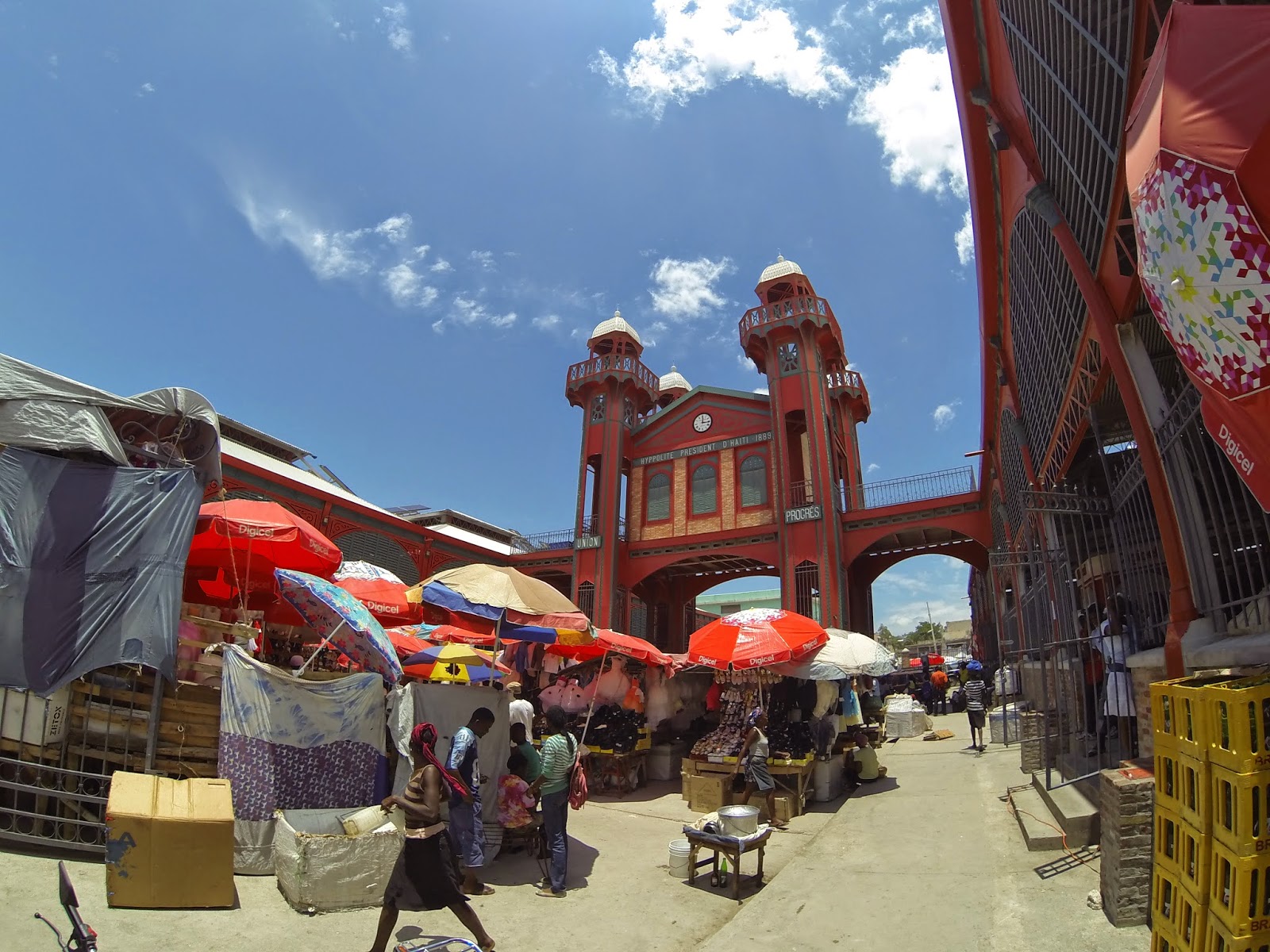
The Iron Market - highlight of Port-au-Prince
Seb and I wandered through for about an hour and we picked up a few of the aforementioned items (mostly beer and other crap) but it was nice to talk to some of the vendors and ask them about how there lives had improved or not in the years following the earthquake. Individually almost everyone agreed that there was still much work to be done to get Port-au-Prince, and Haiti, up and running again but collectively I don't think the people here know exactly how it can and should be done.

Seb with one of his fan club guiding him through the streets
We flew out of PAP bound for Providenciales in the Turks & Caicos. It was a beautiful day for flying and I took a few decent photos of the scenery in and around Port-au-Prince.

Looking East towards the Dominican Republic
Port-au-Prince bay and the city.
HAITI QUICK GUIDE
Capital: Port-au-Prince
Currency: Gourde (USD$1 = 44HTG)
Language: French, Creole
Drives on the Right
Beer of choice: Prestige (also my pick for the best beer in the Caribbean!)

Monday, May 12, 2014

Dominican Republic

CARIBBEAN IN MAY
The May segment of my trip starts in the Dominican Republic with my five year old son Sebastian and will end when I get to my final Caribbean country, The Bahamas, to meet up with Sara and seven year old Lily.

We caught a ridiculously early flight from DFW to MIA followed by a four hour layover before catching our flight to Santo Domingo (SDQ). It was the only way I could use my AA points but it would have been nicer to have a few more hours sleep. Seb slept most of the way so he was well rested when we arrived in the Dominican Republic, but I was a little sleepy.

We didn't need visas for any of the countries on this trip but there is a mandatory Tourist Card to purchase at the airport in Santo Domingo (US$10) before you're allowed to pass through to immigration. There weren't a lot of tourists on our flight so it didn't take long to complete arrival formalities and find the Hertz desk just past customs. We rented a Fiat Panda for three days, without GPS but with automatic transmission, and headed towards the city in pouring rain with standing water everywhere. A wrong turn took me off the freeway and into the downtown area and because of the rain, flooding and traffic it took an hour to get back on. I made the mistake of trusting Google maps with my route and it ended up taking me through a winding road that eventually deteriorated to the point that I had to turn back and try another route - another hour plus wasted. The rain persisted almost the whole drive but when we finally made it to Cabarete after six hours all was forgotten when we arrived at the beautiful Millennium Beach Resort (booked on hotels.com for USD$100).

Millennium Beach Resort & Spa
Cabarete Beach
The resort has an infinity pool overlooking Cabarete Beach where kite boarding is immensely popular. The beach itself is very nice but because of all the kite boarders there are only a few places roped off for swimmers. Cabarete is a windy place and it rained hard every day, but never for very long. Most of the time it was sunny and warm but the fast moving clouds made it difficult to predict when the downpours were about to come.

Cabarete ticks a lot of boxes for the perfect place to spend a few days - great beach, lots of inexpensive restaurants on the beach, decent shopping, a reliable ATM with a security guard, a liquor store, interesting caves and waterfalls nearby, not too many tourists (although this wasn't peak season) and a really relaxed atmosphere. One of the few frustrating things was the maximum withdrawal amount from the ATM (RD$2,500 or about USD$60). I found myself at the ATM everyday trying to make sure I have enough currency to keep us afloat.

We took a different, much quicker, route back to Santo Domingo through Nagua and south through the toll road (about USD$10) only taking about 4 hours including some messing around close to the airport where the signs don't make it obvious where the turnoff it located. We had one night at the Hilton on the Malecon near the old colonial city center but the rain and flooding meant that we didn't get much time to explore the Zona Colonial UNESCO World Heritage Site but we did see the first cathedral in the Americas - La Catedral Primada de America.

The view of Santo Domingo from our room at the Hilton
La Catedral Primada de America
We caught a bus to Haiti the following morning. Caribe Tours runs a luxury bus between Santo Domingo and Petion-Ville, a suburb of Port-au-Prince. The price is somewhat confusing because there are three different parts to it - the bus ticket costs USD$41 ($20 for kids), there is a tax of USD$20 per person, then another tax of RD$200 per person which no-one seems to know what for but everyone pays. I think it relates to some kind of border charge but I couldn't get a straight answer from anyone.

The bus is perfect because it has a toilet (always a plus), shows bad American movies overdubbed in Spanish and serves lunch and drinks. The scenery on the route is interesting, especially close to the border where the road winds around Lake Enriquillo, which is the largest lake and lowest point in the Caribbean (27 meters below sea level) and the lowest point on any ocean island. There are few towns so there is little pollution which makes the scenery that much more impressive.  It was a long trip though - about five hours to get to the border, three hours to cross the border because of the huge customs line on the Haitian side and another three hours to get to the bus depot in Haiti.

I was impressed with the Dominican Republic - it was relatively easy to get around, I had no issues with the rental car or finding gas stations and the countryside is fantastic. Santo Domingo has so much to offer for history buffs as the Columbus brothers spent a lot of time here and Bartholomew Columbus is credited with founding the site in 1496. The beaches and resorts are top notch and then there's the rum and cigars. I don't like to call favorites but Republica Dominicana exceeded my expectations and is one of the few places that I would definitely want to return to.

DOMINICAN REPUBLIC QUICK GUIDE
Capital: Santo Domingo
Currency: Dominican Peso (USD$1 = RD$42)
Language: Spanish
Drives on the Right
Beer of choice: Presidente